Finance and business leaders from across Europe gathered in Warsaw to explore how artificial intelligence is reshaping the finance function, transforming decision-making and redefining the role of people within organisations.
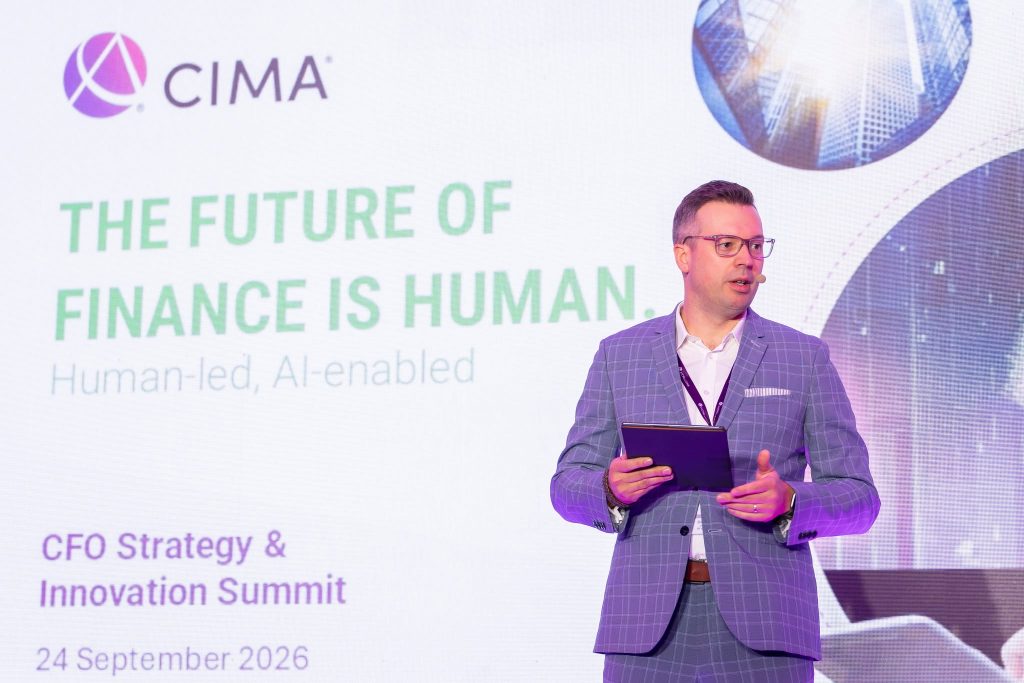
On 24 September, the ninth CFO Strategy & Innovation Summit took place in Poland. Organised by The Chartered Institute of Management Accountants (CIMA), the event brought together CFOs, experts and business practitioners to examine both the opportunities presented by AI and the conditions required to use it responsibly.
Participants explored the transformation of operating models, the challenge of building trust in technology, cyber resilience and the capabilities finance leaders and their teams will need for the future. The summit served not only as a forum for knowledge-sharing but also as a call to action around two closely connected priorities for finance: supporting better business decisions (Business Guidance) and strengthening governance, transparency and trust (Business Governance).
As Jakub Bejnarowicz, Regional Director – Europe at CIMA, said in his opening remarks:
“This year’s theme ‘The Future of Finance Is Human: Human-Led, AI-Enabled’, reflects a simple but important idea: AI may be transforming finance, but people must continue to set the direction, exercise judgement and take responsibility for decisions.”
He added: “The future of finance will not be defined by technology. It will be defined by how thoughtfully we use it, how confidently we lead and how successfully we combine innovation with trust, responsibility and human judgement. Instead of reacting to change, we should anticipate it to turn insight into action, possibility into performance and technological progress into lasting value.”

People set the direction
The summit was hosted by Ash Noah, CPA, FCMA, CGMA, VP & Managing Director, CGMA Learning, Education & Development at CIMA. In his keynote address, he compared the development of artificial intelligence to a runaway train. The key challenge, he argued, is no longer whether technology will take on more tasks, but how to ensure that people remain responsible for setting the direction. Humans must define the purpose and strategy; AI agents can help determine the best way to execute them.
“Today, organisations are still in the early stages of AI adoption, primarily focused on efficiency gains. The next stage requires us to redesign the way organisations operate. That is when we will begin to see greater returns.”
This shift creates a dual challenge for finance. AI can help finance professionals provide stronger business guidance, while at the same time increasing the importance of governance and oversight. According to Ash Noah, balancing those two priorities will be critical.

Foundations for change
How can finance move beyond automating individual tasks to redesigning entire processes, roles and ways of creating value? In his session, “Building the Future Finance Organization: How AI Reshapes Workflows, Roles and Value Creation”, Callum McMahon, Finance Transformation Director at Skyscanner, emphasised the importance of a foundational issue that is often overlooked in discussions about AI agents: the quality of data and documentation. Without those foundations, organisations will struggle to automate activities and scale the use of AI effectively.
He also argued that, as AI becomes embedded across organisations, the real opportunity for finance lies not in automating individual tasks but in redesigning how work gets done.
From pilots to value
The summit repeatedly returned to the question of how organisations can move beyond experimentation and create sustainable business value from AI.
As many speakers noted, successful organisations will be those that embed AI into their operating models rather than treating it as a collection of disconnected pilot projects. AI adoption requires clear accountability, executive sponsorship and governance structures that support measurable business outcomes.
Another recurring theme was that the greatest value from AI may come not from cost reduction but from creating new opportunities for organisations to operate, grow and make decisions in different ways. At the same time, speakers stressed the importance of combining technology investment with changes in operating models, governance and organisational culture.
Global insights, local relevance
The summit’s international perspective was paired with a strong focus on the realities facing organisations in Poland. Ignacy Morawski, Deputy Editor-in-Chief and Chief Economist at Puls Biznesu, and Rebecca McCaffry, FCMA, CGMA, Associate Technical Director, Research and Development at CIMA, presented findings from the joint study AI & the Future of Finance: Hopes, Fears and Readiness.
The research highlighted both the pace of change and the scale of the challenge ahead. Seventy-two per cent of respondents reported an acceleration in AI adoption, while 78 per cent said maintaining professional relevance would require significant skills development. These findings gave practical context to a question that surfaced repeatedly throughout the summit: how can organisations turn readiness for change into lasting business value? The survey findings were then compared with the experiences shared by finance and business leaders during the subsequent panel discussion.
Judgement in a world of AI agents
The closing keynote, “Cheap Intelligence, Expensive Judgment”, delivered by Pascal Finette, shifted the discussion from today’s AI deployments to the longer-term future of work. The bestselling author and business transformation expert argued that organisations must address two emerging challenges: designing environments that determine which data and resources AI agents can access, and defining the authority under which they can act. Finance leaders, he suggested, have an important role to play in setting the controls and boundaries for both.
As Pascal Finette put it: “The key question is: how much work can AI take on without increasing the burden of oversight or raising the level of risk?” The answer, he argued, will not be found in governance frameworks alone. Organisations must also embrace curiosity, experiment with emerging technologies and continuously learn from experience. Technology can expand what finance teams are capable of achieving, but the value it ultimately creates depends on people, their judgement, their willingness to take responsibility and their determination to adapt.
To close the summit, Pascal Finette quoted Alan Turing: “We can only see a short distance ahead, but we can see plenty there that needs to be done.”