

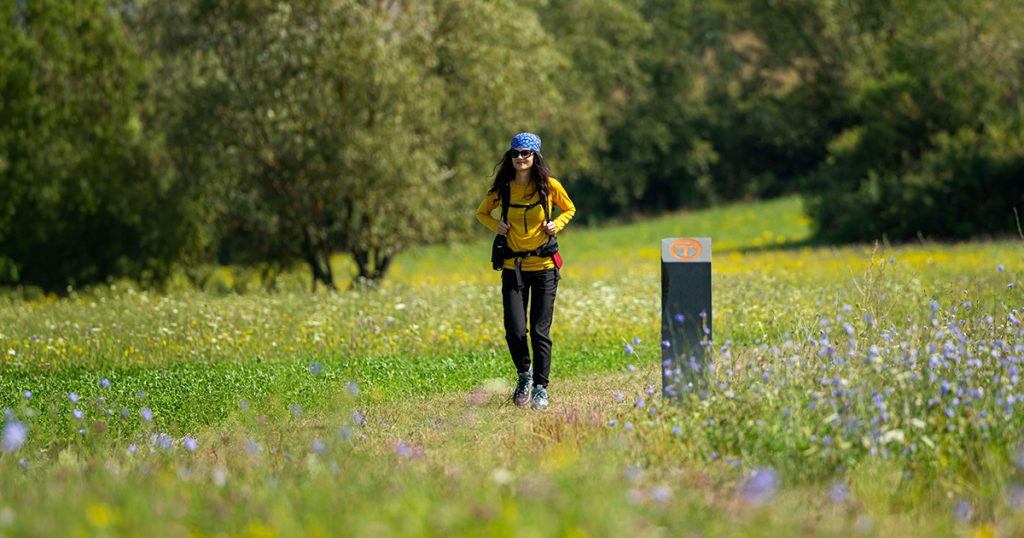
When Walking Becomes “Good Stress”: New Insights from the MedLife Study on Via Transilvanica
When the enthusiasm of a voluntarily undertaken challenge begins to fade and effort and fatigue start to make themselves felt, people do not necessarily abandon their goals. Instead, they find new sources of motivation to keep going. This is one of the conclusions of a new interim stage of the observational study conducted by MedLife and the Tășuleasa Social Association on Via Transilvanica, aimed at assessing the impact of walking on health.

More than 60 Romanians accepted the challenge of walking the trail for 10 days and covering at least 150 kilometers — an experience involving physical effort, consecutive days of walking, fatigue, and adaptation. This is what the MedLife project explores through the concept of “good stress”: a voluntary, time-bound, and meaningful challenge that can activate the body’s natural adaptation mechanisms.
While in the first stage of the study, the initiators sought to outline the participants’ profile and understand the motivations behind their decision to take part in the project, this time they started from a different question: what motivates participants to continue when the initial enthusiasm is replaced by effort, fatigue, and the routine of walking day after day?
The data analyzed so far show that, although each participant initially had a clear objective — whether to break out of their routine, socialize, test their limits, or mark a period of change — motivation evolves throughout the experience. The pleasure of walking, the satisfaction of making progress, the time spent with themselves, and the desire to honor their own commitment gradually become new sources of energy.
Thus, the initial motivations do not disappear, but rather evolve and become stronger, with every kilometer bringing new reasons to keep moving forward, even when returning to the comfort zone becomes increasingly tempting.
When Progress Becomes Motivation
For many participants, the first few days involve a period of adaptation. The body gradually adjusts to the physical effort, and walking, initially perceived as a challenge, begins to become a routine or even a source of pleasure. From this point onward, motivation no longer comes exclusively from the final goal, but also from the satisfaction of each day spent on the trail.
At the same time, physical effort creates a contrast with everyday life: after a day of walking, rest takes on a different intensity. Sleep and recovery become part of the experience, while fatigue is no longer perceived as an obstacle, but as a natural consequence of a day spent pursuing a clear goal.
Digital Disconnection Makes Room for Reflection
During in-depth discussions, some participants spoke about moments of reflection that emerged along the trail. Without the pressure of their usual schedules, notifications, and everyday responsibilities, time and space become available for personal transformations and insights.
Digital disconnection thus becomes more than a break from ordinary life: it becomes an immersion in a completely different experience, creating room for curiosity and new perspectives.
Nature and Community: From Individual Effort to a Shared Goal
As participants spend more time on the trail, nature becomes more than just the backdrop to their experience. The rhythm of walking, the absence of familiar stimuli, and the time spent outdoors contribute to their desire to keep going.
At the same time, connections with others take on a different form. For those completing the trail with a partner or as part of a group, the shared experience becomes a source of motivation. The effort, breaks, difficult moments, and achievements are shared, and the individual goal sometimes evolves into a common one.
Another dimension emerges through interactions with local communities. Meeting people in the towns and villages along the route, hearing their stories, and experiencing a different pace of life firsthand add a social dimension to the journey. The trail is no longer simply a distance to be covered, but becomes a space for encounters and discovery.
Consistency and Contributing to Science as Sources of Motivation
For some participants, one of the strongest motivating factors is their commitment to themselves. After deciding to embark on a 10-day journey along the trail, participants want to prove to themselves that they can keep a promise they have made to themselves, even when not every day is easy. In this context, consistency becomes a source of motivation in its own right. Each day they choose to continue provides further confirmation that they can follow through on a goal they have started.
Last but not least, for those included in the observational study, there is an additional motivation: the fact that their experience contributes to a research project with long-term impact. The analyses and assessments conducted before and after the journey, together with the data collected along the way, may contribute to a better understanding of the relationship between physical activity, challenge, and well-being.
“In the first stage, we wanted to understand what makes people say ‘yes’ to the challenge of walking for 10 days on Via Transilvanica. Now, it is interesting to observe what happens after they take the first step and how their motivation changes as they progress along the trail. This is also one of the important dimensions of this project. We live at a pace where we expect quick results, yet many of the things that matter for our health and well-being are built over time, through consistency. Via Transilvanica gives us a very concrete way to observe this: you take one step, then another, and at some point you look back and see how far you have managed to go.
For us, the next question is what remains after the experience ends. What happens to this motivation, to the sense of consistency, and to the resources participants say they discovered along the trail, and whether we can identify, in parallel, relevant changes in the medical data we collect. Ultimately, we want to understand to what extent long-distance walking can influence indicators of physical and emotional health, as well as how the body adapts to sustained physical effort and this type of good stress,” said Ina Bădărău-Ilie, Head of Communications, MedLife Group.
According to company representatives, the fieldwork period concluded at the end of September, with the final participants completing the 10-day challenge on Via Transilvanica. In the coming period, the data collected before and after the experience — ranging from medical tests to psycho-emotional assessments — will be comparatively analyzed to evaluate the impact of long-distance walking on physical and emotional health and to identify potential changes associated with the period of sustained effort.
The final results of the study will be published in early November.
By M.M.