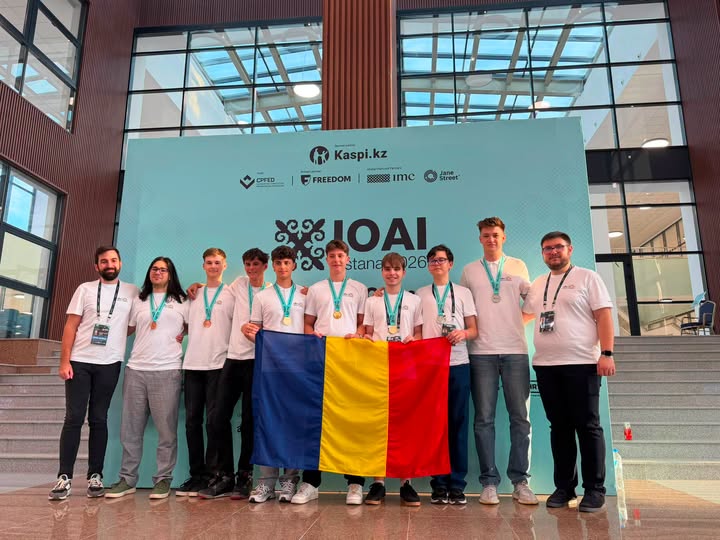
Romania won eight medals at the International Olympiad in Artificial Intelligence (IOAI), held in Astana, Kazakhstan, from 2 to 8 August 2026. Among the winners was Alexandru Thury-Burileanu, a student at Mircea cel Bătrân National College in Constanța, who earned a gold medal. At just 18, he hopes to continue his studies in artificial intelligence abroad.
Artificial intelligence and cybersecurity are two of the fields increasingly shaping our world. Behind the technologies transforming business, education and communication are young people passionate about mathematics, computer science and algorithms. Romanian students are proving that they can achieve remarkable results in international competitions in these rapidly developing fields.
One such student is Alexandru Thury-Burileanu, from Mircea cel Bătrân National College in Constanța, who won gold at the International Olympiad in Artificial Intelligence, a competition designed to challenge young people with advanced skills in the field.
The challenges required far more than programming knowledge. Participants had to analyse complex problems, develop algorithmic solutions and apply artificial intelligence concepts to tasks involving image processing, text analysis and machine learning.
Alexandru Thury-Burileanu, AI Olympiad gold medallist: “We had to solve six different problems over two days, and each one tested us on different things. Some problems were about images, some about text, and some about machine learning.”

Alexandru hopes to deepen his knowledge of the subject and continue his studies abroad, where he aims to pursue further opportunities in artificial intelligence education and research.
Eight students, eight medals for Romania
The Romanian team’s results demonstrate the high level of preparation among students passionate about computer science and technology. All eight members of the Romanian delegation won medals: three gold, two silver and three bronze.
The gold medallists were:
- Alexandru Thury-Burileanu, Mircea cel Bătrân National College, Constanța
- David Georgescu, Constantin Diaconovici Loga National College, Timișoara;
- Roland Petrean, Silvania National College, Zalău.
The silver medals went to:
- Mihnea-Teodor Stoica, International Computer High School of Bucharest;
- Darius-Adrian Dobre, Matei Basarab National College of Computer Science, Râmnicu Vâlcea.
The bronze medallists were:
- Iulian Nistor, Tiberiu Popoviciu Computer Science High School, Cluj-Napoca;
- Daniel-Antoniu Bence-Muk, George Barițiu National College, Cluj-Napoca;
- Matei-Tudor Pop, Avram Iancu Theoretical High School, Cluj-Napoca.
The results represent a significant achievement for Romania in a technological field that is advancing at an extraordinary pace.
Challenges that push the boundaries of programming
For the students, one of the most difficult aspects of the competition was tackling unfamiliar problems that demanded analytical thinking and the ability to develop algorithms for new situations.
David Istrate described a language-translation problem that involved identifying invented languages from texts containing elements of different languages.
David Istrate, student: “The hardest problem, I think, was a language-translation problem. The whole idea was that you were given several texts combining different languages, and you had to create a programme that could work out which invented language each text belonged to.”
Challenges like these illustrate the complexity of artificial intelligence. Developing systems that can analyse language or interpret images requires mathematics, logic, programming and a deep understanding of how data can be processed and interpreted.
From artificial intelligence to cybersecurity
Romanian students’ interest in advanced technology also extends to cybersecurity, a field that plays a vital role in protecting data, communications and digital infrastructure.
Vladimir Albu, an 11th-grade student, explained how mathematics and cryptography formed an important part of his preparation for Olympiad competitions.
Vladimir Albu, student: “To prepare for the Olympiad, I studied a great deal of cryptography and mathematics. I worked on proving theorems and studying cryptographic algorithms, and that helped me a lot in both the national and international competitions.”
Cryptography underpins many digital security systems, from protecting communications to authenticating users. Although artificial intelligence and cybersecurity require different specialist skills, both rely on mathematical rigour, problem-solving and the ability to understand complex systems.
Students learning beyond the classroom
International achievements often reflect work that goes well beyond regular school lessons. In rapidly evolving fields, students must study independently, test ideas and explore new concepts.
Janetta Bărăitaru, deputy headteacher at Mircea cel Bătrân National College in Constanța, highlighted how quickly these disciplines have become part of everyday life and school competitions.
Janetta Bărăitaru, deputy headteacher: “These are new fields that are advancing very rapidly. They have made their way, gradually or quite openly, into our lives, and now they have also become part of national and international school Olympiad competitions.”
Teacher Laura Giuglea emphasised the students’ ability to learn independently.
Laura Giuglea, teacher: “They are essentially self-taught. That makes their achievement even greater, because we have to think about how difficult it is, even for us as adults, to discover something new on our own.”
This ability to learn independently is particularly valuable in a field where methods, tools and applications are constantly changing. For young people hoping to build careers in technology, curiosity and a commitment to continuous learning can be just as important as formal education.
Corina Martin, Honorary Consul of the Republic of Kazakhstan in Constanța:
“In his opening address at the Olympiad, the President of Kazakhstan described artificial intelligence as one of the central pillars of the country’s long-term development strategy.
President Kassym-Jomart Tokayev noted that the Republic of Kazakhstan had made a strategic choice in favour of digital transformation, highlighting the country’s 24th-place ranking in the United Nations E-Government Development Index and its leading position in Central Asia in terms of technological readiness.
AI is indeed becoming an essential tool for the Kazakh government, as well as for businesses and public services, as Kazakhstan works towards becoming a fully digital state within three years.
Designating 2026 as the Year of Digitalization and Artificial Intelligence in Kazakhstan, and enshrining innovation in the country’s new Constitution, are intended to accelerate this transition.
I warmly congratulate Alexandru Thury-Burileanu, the student from Constanța, who has returned to Kazakhstan and brought home another gold medal. He had previously also won a medal at the International Olympiad in Mathematics and Informatics held in Astana in January 2025, alongside the team from ‘Mircea cel Bătrân’ National College in Constanța.
Congratulations to the entire Romanian team—all eight participating students who won medals, as well as their coordinating teachers!”
How can Romania nurture and retain its young talent?
The eight medals won at the International Olympiad in Artificial Intelligence are a major achievement for the students, their teachers and the educational communities supporting them. At the same time, the results highlight an important challenge: creating opportunities for talented young people to continue developing their skills and contribute to research and innovation.
Modern laboratories, mentoring, university partnerships and access to research projects can help turn Olympiad success into long-term achievements. As artificial intelligence and cybersecurity become increasingly important to the global economy, developing skilled specialists is an investment in the future.
For Alexandru Thury-Burileanu, the gold medal is an important milestone in a journey that is only beginning. His ambition to study artificial intelligence abroad reflects his determination to deepen his expertise in a field offering opportunities around the world.
The Romanian students’ achievements demonstrate that the country has young people with the talent and passion to excel in technology. The challenge now is to support and develop that potential so that today’s students can help shape Romania’s technological future.