

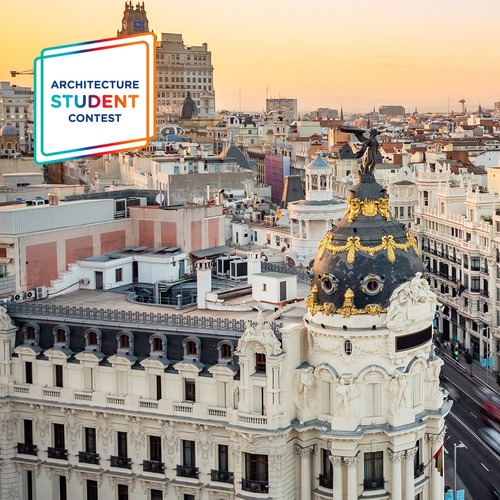
Saint-Gobain Romania launches the national stage of the 22nd edition of the International Architecture Student Contest. Until March 15, 2027, future architects, designers and engineers from Romania are invited to take on an unprecedented urban challenge as part of one of Europe’s most ambitious urban regeneration projects. The winning project of the national stage will represent Romania at the international final, hosted by Madrid from June 14–16, 2027.
Designing a new mixed-use integrated development, renovating a residential building within a historic housing complex, and creating a 1.2-kilometre green corridor that connects the two not only physically but also conceptually: this is the challenge set for participants in this year’s competition, inviting them to imagine and shape the Madrid of the future.
The 22nd edition of the International Architecture Student Contest proposes the most extensive and complex design brief in the competition’s history. It is a highly challenging project that requires participants to integrate three distinct interventions into a single, coherent urban vision: designing a new mixed-use building, rehabilitating and repurposing a heritage property, and developing a green corridor that creates both a functional and an identity-based connection between the two.
All three components are located in the heart of the Nuevo Norte area of Madrid, where Europe’s largest urban regeneration project currently underway is being implemented.
With more than two decades of history, the Architecture Student Contest has become one of the most important international competitions dedicated to future professionals in the built environment. From Madrid and Dubai to Milan, Paris, Warsaw, Lisbon, Helsinki and Belgrade, the competition has consistently brought real urban projects and innovative solutions for the cities of the future into the spotlight. The previous edition, hosted by Belgrade, brought together approximately 1,400 students from 34 countries.
Romania already has an impressive track record in the competition. In 2025, the team comprising Victoria Cravcenco, Mara Ioana Craiu and Ancuța-Larisa-Mihaela Petrescu, coordinated by Professor Cătălina Bocan from the Faculty of Architecture and Urban Planning in Timișoara, won the Student Prize at the international stage of the competition.
This year’s edition is being held in partnership with Ayuntamiento de Madrid, CREA Madrid Nuevo Norte, CSCAE (Consejo Superior de los Colegios de Arquitectos de España), World Green Building Council, OneClick LCA and Saint-Gobain Spain.
One Proposal, Three Challenges
The area selected for this year’s competition brief, Madrid Nuevo Norte, aims to transform more than 2.3 million square metres of former railway land into a new neighbourhood featuring approximately 10,500 homes and 400,000 square metres of green spaces.
The ambition of the competition matches the scale of this urban transformation. Participants are required to develop an integrated solution addressing three design challenges simultaneously, which will be evaluated by the jury as components of the same urban concept:
Component A – New Construction: An integrated development with a total gross floor area of approximately 10,000 square metres, including a mixed-use building comprising primary healthcare facilities (3,000–3,500 sqm) and a senior living community (6,500–7,000 sqm), together with a green public space. The objective is to address the challenges of an ageing population by integrating health, wellbeing and community life within a sustainable urban environment.
Component B – Renovation: The rehabilitation of a representative residential block within the San Cristóbal social housing complex, one of Madrid’s most valuable examples of modern social architecture, designed by Secundino Zuazo Ugalde. The proposed interventions must significantly improve living conditions while respecting the architectural character and heritage status of the complex, transforming the building into a contemporary model of sustainable renovation that could be replicated across the entire complex of approximately 800 homes.
Component C – Green Axis: A linear park approximately 1,200 metres long, connecting the historic neighbourhood with the new Madrid Nuevo Norte development. Students must propose an overall concept for the entire green corridor and develop two representative sections focusing on the relationship between heritage, public space and new urban development.
“A neighbourhood is not transformed through a single intervention. It is transformed when buildings, public spaces and the people who use them can coexist harmoniously, creating together a resilient urban ecosystem. This is what we are asking students to do this year: design responsibly for people and the environment, in a real context with real constraints, because we already know that the future of construction will belong to those who learn how to transform spaces into places with identity and meaning that improve the lives of the people who use them,” said Jakub Kotala, CEO of Saint-Gobain Romania.
The underlying challenge of the competition is therefore to ensure that these three elements work together for the same people. Elderly residents, patients and future inhabitants should be able to walk safely and comfortably between the key points of the proposed development, even when faced with the extremely high temperatures increasingly characteristic of Madrid’s hotter summers.
Designing with Professional Tools
A key new feature of this year’s edition is the encouragement to use new technologies, subject to one clear condition: the project must be the result of teamwork, without conceptual intervention from artificial intelligence. AI tools may be used for research or analysis, provided that their use is clearly declared in the project documentation. However, the concept, design decisions and technical solutions must remain entirely the work of the participating team.
Between November 2026 and March 2027, free on-site and online training sessions will be offered. The sessions will also be recorded and made available subsequently on the competition’s YouTube channel.
Participants will also have the opportunity to work with professional tools used in real-world practice. Saint-Gobain will provide access to a SketchUp licence, the SG SAVE International plugin for energy simulations, and a OneClick LCA licence for analysing carbon emissions throughout the entire life cycle of a project.
Students of architecture, design, civil engineering and related disciplines may enter the competition individually or in teams of up to three members, together with a supervising professor. Teams may submit their projects for the national stage of the competition until March 15, 2027, at 6:00 p.m.
Saint-Gobain will cover the transportation and accommodation costs of the Romanian team travelling to Madrid.
National Stage Calendar
- March 15, 2027, 6:00 p.m. – Deadline for registration on the international competition platform
- April 12, 2027, 6:00 p.m. – End of the national stage
- May 12, 2027 – Submission of the national winning project to the international jury