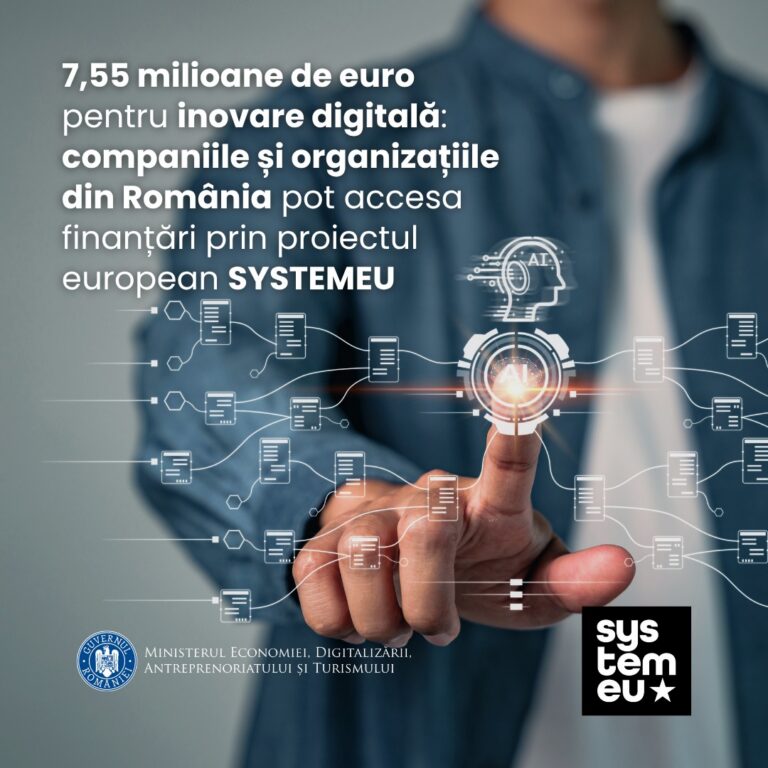
The Ministry of Economy, Digitalization, Entrepreneurship and Tourism (MEDAT) announces the opening of the Call for Financial Support for Third Parties (FSTP), worth a total of 7.55 million euros. The call funds interregional innovation projects dedicated to the digital transformation in health, energy and mobility and is open until 16 November 2026.
Entities across the country can access funding of up to €2.2 million for projects that take digital solutions from the prototype phase to market launch.
MEDAT is a partner in the European project SYSTEMEU together with the Municipality of Cluj-Napoca and the C-EDU Education Cluster Association. Romania participates in SYSTEMEU at national level, which means that any company, start-up, university, research organization, public authority or non-governmental organization, based in Romania, can be part of an eligible consortium, together with partners from the other four regions of the project (Bavaria, Castilla y León, Norte Region and Tuzla Canton).
The selected projects will develop, test and validate digital solutions in real conditions, starting from a minimum level of technological maturity, from a functional prototype, already tested under realistic conditions and reaching a completed and validated solution, ready for the market or for real use.
The targeted areas are:
- Health – digital health and medtech;
- Energy – decentralised, clean and smart energy networks;
- Mobility – intelligent transport and logistics systems.
Between 5 and 8 projects will be selected, on three funding thresholds:
- Small projects – up to 750 thousand euros;
- Mid-level projects – up to €1.1 million, with consortia of 3–5 entities from at least three participating regions, including a research organisation and a company;
- Flagship projects – up to €2.2 million, with consortia of 5–8 entities from all five SYSTEMEU regions, set up under the Triple Helix model, bringing together at least one research organisation, one company and one public authority or public sector organisation.
Funding rates are up to 100% for start-ups, 70% for SMEs, 50% for large enterprises and 100% for public bodies, NGOs and research organisations. Individual entities can participate in several projects, but the total funding received for all selected projects in which it is part of the consortium cannot exceed 600 thousand euros, according to the FSPT funding mechanism.
The projects will run for a period of between 15 and 18 months, with implementation scheduled to start in February – March 2027.
Support for candidates from Romania
- All information about the call and application submission can be found on the official FSTP portal: https://opportunities.getonepass.eu/open-opportunities/systemeu/systemeu-fstpcall
For questions related to the call, please write to helpdesk_opencall_systemeu@sce.de.
To support applicants in setting up interregional consortia that meet the eligibility criteria, the SYSTEMEU project provides access to a dedicated online database to facilitate the establishment of partnerships.
SYSTEMEU Open Hubs Community Platform: Candidates can register, publish concrete project proposals and view other registered profiles. Access is available at: https://openhubs.io/topics/47675/feed.
About SYSTEMEU
SYSTEMEU is a project funded by the Horizon Europe Program (European Innovation Ecosystems), carried out between January 1, 2025 and December 31, 2028, with a total estimated budget of approximately 14.87 million euros, based on the Grant Agreement no. 101161224. The project connects universities, research organisations, companies, public authorities and innovation actors from five European regions – Bavaria (Germany), North-West Romania, Castilla y Leon (Spain), the Canton of Tuzla (Bosnia and Herzegovina) and the Northern Region (Portugal), with the aim of reducing territorial innovation gaps, strengthening competitiveness and accelerating the digital transformation in health, energy and mobility. In Romania, SYSTEMEU is implemented by the Ministry of Economy, Digitalization, Entrepreneurship and Tourism, the Municipality of Cluj-Napoca and the C-EDU Education Cluster Association